
Summer Doesn’t Pause Injustice
A personal reflection on Julian's first years of freedom, the twelve summers he lost, and why preserving memory has become the next chapter of the story.

Dear friends, and supporters,
Dear guardians of the Julian Assange Archive,
Two years ago, one week after Julian Assange walked free, we gathered in Berlin to celebrate his fifty-third birthday. It was one of those rare evenings suspended somewhere between relief and disbelief. For years we had imagined what that day might feel like, yet when it finally arrived, it almost defied comprehension. During my speech, I found myself saying something that had lived quietly in my mind for years.
“As I always said, when Julian is free, the real work begins.”
At the time, I did not fully appreciate why those words came so naturally. Looking back now, two years later, surrounded by thousands of letters, banners, artworks and personal belongings entrusted to the Julian Assange Archive, I realise they were never really about the end of a campaign. They were about the beginning of memory.
There are moments that become fixed in your mind for the rest of your life. For me, Julian’s release is one of them. I suspect everyone who stood beside him throughout those long years remembers exactly where they were when the news finally arrived.
I had only just woken up, sometime around half past two in the morning, because my phone buzzed with a WhatsApp message containing nothing more than a link to a news article in Die Welt. I stared at the headline and instinctively refused to believe it. After years of hearings, appeals, rumours, disappointments and false hope, disbelief had become second nature. My first thought was that there must be another twist waiting just beyond the headline, another legal obstacle that would once again place freedom beyond reach. Rather than reading further, I went straight to Stella Assange’s x-account. There, pinned at the very top, were three simple words.
“Julian is free.” and a picture of Julian walking up a plane…
Only then did I allow myself to believe that history had quietly changed overnight.
For more than a decade, so much of our collective energy had been directed towards a single objective that its achievement left behind an unfamiliar silence. Campaigns develop a rhythm of their own. They tell you where to stand, what to organise, which hearing to attend and what still needs to be done. When that purpose is finally fulfilled, another question quietly presents itself.
What becomes of everything that brought us here?
Campaigns conclude. Memory does not.
This summer marks another season of freedom for Julian. Even now, those words carry a quiet sense of disbelief when one remembers that from the day he entered the Ecuadorian Embassy in London in June 2012 until his release in June 2024, he lost twelve consecutive summers to confinement. Twelve summers in which the changing of the seasons could only be observed through windows, courtyards or prison walls. Twelve summers without deciding, on a warm evening, simply to walk through a park, sit beside the sea, linger over coffee with friends or wander wherever curiosity happened to lead.
Summer has a curious way of disguising how precious ordinary freedom really is. We complain about the heat, postpone things until September, make holiday plans and assume another summer will always follow. Yet freedom rarely announces itself with grand gestures. More often, it exists in life’s smallest decisions: opening the front door without permission, choosing a destination without restriction or staying a little longer because nobody is waiting to lock the door behind you. We only recognise the extraordinary value of those ordinary moments once they have been taken away.
Perhaps that is why summer feels different inside the Archive.
People often imagine an archive as a place where boxes are quietly stacked on shelves and forgotten. Nothing could be further from the truth. Every box asks questions. Every letter carries a voice. Every handmade banner, faded campaign badge, photograph and hastily scribbled note forms part of a much larger story that could so easily disappear if nobody accepts the responsibility of preserving it.
Perhaps years of working as an artist have simply taught me to see objects differently. I have never believed that they are merely objects. A faded banner remembers the hands that painted it. A letter remembers the person who folded it. A prison envelope is never simply paper. Every crease, every stain and every fingerprint becomes part of the story itself. Official documents preserve facts; objects preserve humanity.
While much of the world quite rightly slows its pace during the summer months, ours continues almost unchanged. Days are spent cataloguing collections, identifying photographs, tracing provenance, preserving fragile materials and documenting objects whose true value has nothing to do with money and everything to do with memory. Some discoveries stop us in our tracks. Others reveal their significance only after hours of patient research. Much of what we do will never attract headlines, yet without that patient, almost invisible labour there can be no archive worthy of the trust placed in it.
When we first imagined opening our inaugural exhibition this summer, we did so with genuine optimism. That will now have to wait.
Not because we have changed our minds, nor because our ambition has diminished, but because we refuse to compromise the history entrusted to us.
The simple reality is that we have not yet secured the financial resources required to create the exhibition we believe this remarkable collection deserves. We could undoubtedly have assembled something smaller, accepted compromises or hurried towards an opening date simply because the calendar suggested we should. I have never believed in doing half a job, particularly where history is concerned. Everything entrusted to the Archive carries the weight of a movement that crossed continents and changed countless lives. It deserves thoughtful research, careful conservation and the kind of curatorial attention that allows visitors not merely to understand what happened, but to feel why it mattered.
We shall open those doors when we are able to do justice to the collection—not simply when it is convenient to do so.
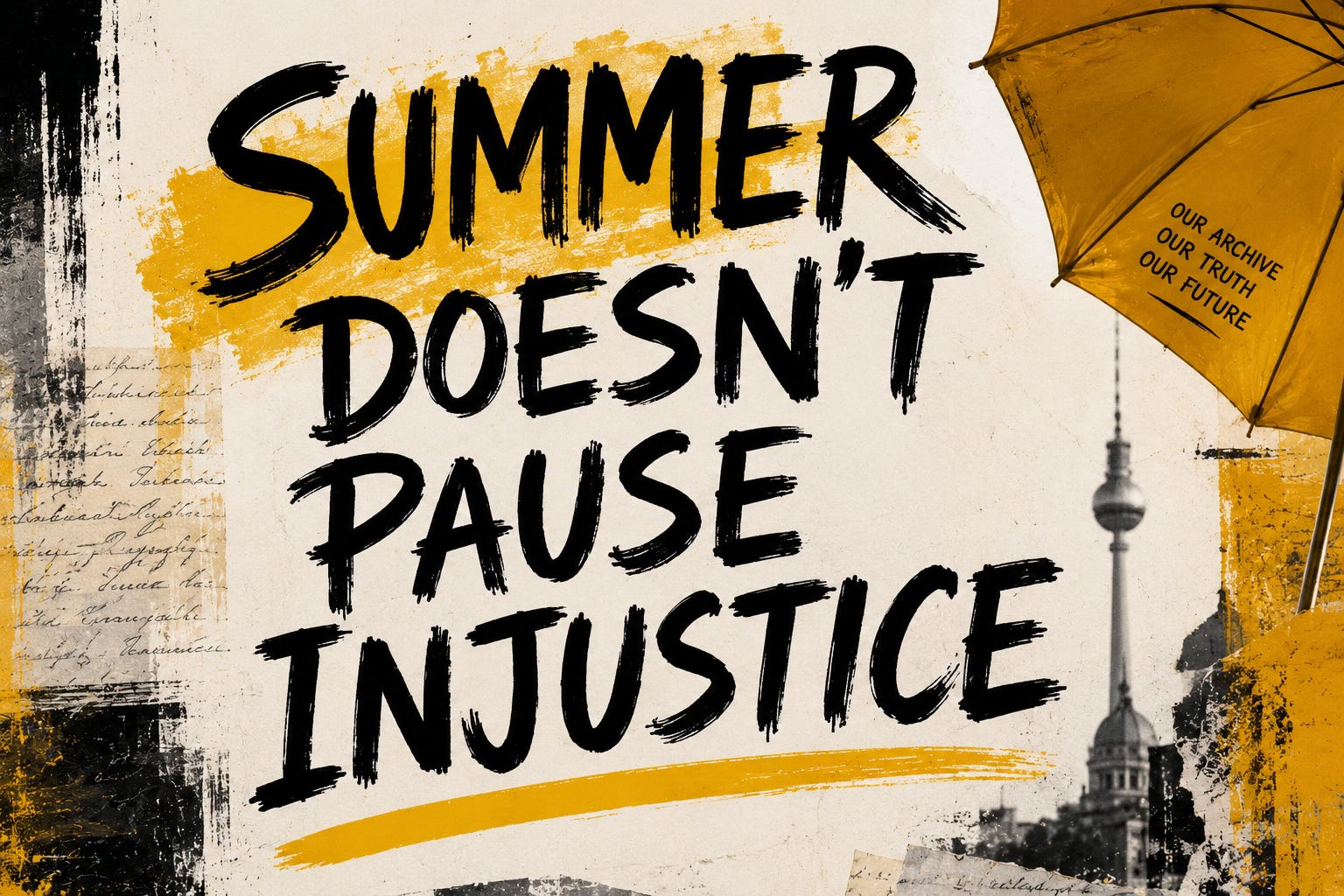
There is no disappointment in acknowledging that reality. Independence has always meant accepting that meaningful work rarely follows the timetable we would choose for ourselves. We answer neither to governments nor to institutions, and that freedom allows us to make decisions based not on convenience, but on principle. If the movement surrounding Julian taught us anything, it is that perseverance has always mattered far more than speed.
What continues to move me most as I work through the collections is not the prominence of the people involved, but their profound ordinariness. This movement was never carried solely by politicians, lawyers or public figures. It was carried by teachers, students, pensioners, artists, parents, journalists and complete strangers who quietly refused to look away. They travelled across countries to attend hearings, stood outside embassies in the rain, painted banners on kitchen tables, wrote letters they hoped might somehow reach a prison cell and devoted years of their lives to defending someone many of them would never meet.
History has a habit of remembering famous names. Archives have the privilege of remembering everyone else.
One day, researchers will read the court judgments, the diplomatic correspondence and the newspaper headlines. Those records matter, and they will always remain an essential part of the historical record. Yet they cannot tell us how hope survived through years of disappointment, how strangers became lifelong friends while waiting outside courtrooms, or how thousands of ordinary people quietly chose compassion over indifference. They cannot tell us what it felt like to stand in silent solidarity outside Belmarsh on a cold winter morning, or why people continued to return, year after year, long after the world’s attention had drifted elsewhere.
Those stories survive in letters, photographs, artworks and the most ordinary of objects. More importantly, they survive because someone chooses to preserve them.
Perhaps that is why I now understand what I meant in Berlin.
It was never a slogan, nor something I had prepared in advance. Somewhere, without quite realising it, I already understood that winning a campaign and preserving its history are two entirely different responsibilities. One belongs to the present. The other belongs to the future.
The Julian Assange Archive has never belonged to one individual. It belongs to everyone who stood in the rain outside an embassy, travelled through the night to attend a hearing, wrote a letter in the hope that it would reach a prison cell, created a work of art, or simply refused to look away when it would have been easier to do so. Preserving that history is not an act of nostalgia. It is an act of responsibility.
There is something quietly deceptive about summer. The longer days encourage us to believe that difficult questions can wait until autumn and that history itself has decided to take a short holiday. Yet injustice has never recognised the changing of the seasons, and neither should our commitment to remembering it. While people rightly enjoy the freedom to travel, to rest and to spend time with those they love, we shall continue opening boxes, preserving letters and carefully piecing together a story that deserves to outlive all of us.
As this essay is published just after midnight in Berlin, it also marks the beginning of 3 July here in Germany.
Happy Birthday, Julian. I hope this one feels wonderfully, gloriously ordinary. The chance to spend your birthday surrounded by the people you love. After everything that came before, perhaps there is no greater gift than that.
Warm regards,
Manja McCade
Chairwoman
Julian Assange Archive e.V.
Become a Guardian
The Julian Assange Archive is an independent, community-funded project dedicated to preserving the history of one of the most significant press freedom movements of our time. We receive no institutional funding, and every contribution helps us continue preserving, researching and, ultimately, creating the public exhibition this remarkable collection deserves.
If you would like to become a Guardian, you can support the Archive here:
The Guardian Option (preset to €1)
Make a one-off contribution. It is preset to €1, but you are welcome to increase the amount if you wish.
👉 Become a Guardian via Stripe
If you prefer to support us via GoFundMe, cryptocurrency or direct bank transfer, you can find all available options here:
👉 Support via GoFundMe, Crypto or Bank Deposit
Thank you for helping us ensure that this history is preserved—not only for today, but for generations to come.
I keep wondering why wikileaks is not being used by investigative journslists that cover Epstein.
We have included Bill Astore’s Independence Day Declaration after the colonist narration of the Declaration of Independence on July 4th 1776, 250 years ago technology, into the new megamovie.
https://storage.to/I6YjuGmHe