
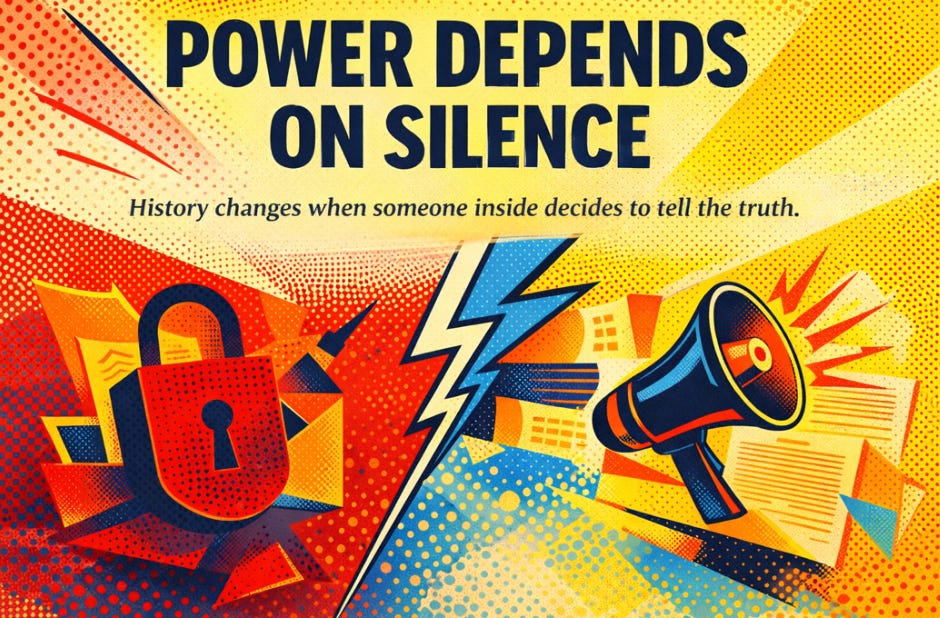
Power Depends on Silence
History changes when someone inside decides to tell the truth

Dear friends,
In the winter of 1777, two men in the American navy made a dangerous decision.
They had witnessed something they believed the public should know: their commander, Commodore Esek Hopkins, had been abusing British prisoners of war. The men — Samuel Shaw and Richard Marven — were not activists and they were not journalists. They were naval officers inside the system, and they understood what speaking out might cost them.
Military hierarchies are built on obedience. Commanders are not meant to be questioned by subordinates, and accusing one of misconduct was almost unthinkable. Yet the two men reported what they had seen.
The response was swift. Hopkins retaliated. Shaw and Marven were arrested, imprisoned, and publicly denounced. The message was clear: silence would have been safer.
But something unusual happened next.
When the case reached the Continental Congress, the lawmakers issued a statement that would echo across centuries. It was, they declared, the duty of citizens to report misconduct by public officials. Congress even paid the whistleblowers’ legal expenses.
In 1778, one of the earliest protections for whistleblowers in modern history was written into law. It recognised a principle that every society eventually confronts: power cannot hold itself accountable. Sometimes the truth must come from within.
The Instinct of Power
Every system of power has the same instinct: to close ranks, to hide the evidence, and to insist nothing is wrong.
Empires did it. Kingdoms did it. Modern governments do it with far greater sophistication. The machinery changes — parchment, filing cabinets, classified databases — but the instinct remains the same.
When something goes wrong inside powerful institutions, the first response is rarely accountability. It is secrecy.
Which is why societies throughout history have depended on a particular kind of person: someone inside the system who decides that the truth matters more than the consequences. Today we call them “whistleblowers”.
But the act itself is far older than the word.
Kautilya’s Observation
More than two thousand years ago, a political strategist in ancient India made a blunt observation about government.
Officials, he wrote, will steal — not occasionally, not rarely, but inevitably.
The strategist was Kautilya, adviser to the Mauryan Empire, and his handbook of governance — the “Arthashastra” — remains one of the most pragmatic texts on statecraft ever written.
His metaphor was simple. Fish swimming through water cannot easily be observed drinking it. Power works the same way.
Those who control institutions are often the only ones able to conceal their abuses. Corruption flourishes not because it is difficult to recognise, but because it is difficult to expose.
Kautilya’s solution was not moral instruction. It was exposure.
He proposed networks of insiders who could reveal corruption inside the state apparatus itself. In some cases they would even be rewarded for reporting wrongdoing.
More than 2000 years ago, a government recognised something modern societies still struggle to admit: if wrongdoing is hidden inside institutions, someone inside those institutions must reveal it.
A Pattern Across History
The pattern appears again and again across history.
In ancient Rome, citizens reported corruption and fraud within the state. In imperial China, officials known as censors were tasked with reporting abuses directly to the emperor. Across centuries the same drama repeats.
An insider sees something they should not have seen — evidence of deception, abuse, corruption, or crimes carried out behind closed doors. A choice appears: remain silent, or speak.
This publication is part of the work of Julian Assange Archive e.V., preserving the history of the global movement that fought to free Julian Assange.Our archive safeguards protest materials, banners, artworks and documents from that extraordinary struggle. Entrusted to us by Julian and his team are also thousands of letters sent to him by supporters around the world, along with a number of his personal belongings from those years.
If this work matters to you, you can support the archive by becoming a Guardian of the Archive through a paid subscription here on Substack or through a direct donation. Both help us continue preserving and building the archive.
The Cost of Speaking
For the individual, the consequences are rarely gentle. Careers end, freedom is threatened, and reputations are destroyed.
But silence has consequences too.
When wrongdoing remains hidden, it becomes policy. Wars continue, abuses multiply, and systems of secrecy grow stronger.
Some of the most important revelations in modern history did not come from official investigations. They came from individuals who refused to keep quiet.
The Structural Problem
For most of history, however, whistleblowers faced a final obstacle.
Even if they chose to speak, there was often nowhere safe to go. Governments controlled information, newspapers relied heavily on official sources, publishers could be pressured or censored, and editors could spike stories.
A whistleblower might possess evidence of enormous public importance yet still be unable to show it to the world. Truth could exist, but it could still be buried.
This was the structural problem of modern secrecy.
Until, in 2006, something fundamentally new appeared.
The Infrastructure of Whistleblowing
WikiLeaks did not simply publish leaks. It built infrastructure for whistleblowing.
For the first time in history, there existed a global platform designed specifically for insiders with evidence of wrongdoing. It allowed documents to be submitted anonymously, protected sources through cryptography, and most importantly published primary evidence — not just descriptions of it.
This difference was revolutionary.
Governments are highly skilled at dismissing allegations. They question motives, attack credibility, and deny accusations. Documents are harder to dismiss.
A military report describing civilian deaths, a diplomatic cable revealing private negotiations, or an intelligence file outlining surveillance programmes allows the public to see the machinery of power directly.
WikiLeaks transformed whistleblowing from a fragile act of individual courage into something more durable. It gave whistleblowers a route to the public that did not depend entirely on institutional gatekeepers.
For the first time, someone inside the system could reveal evidence of wrongdoing to the entire world — not quietly and not selectively, but globally.
When Infrastructure Changes Power
The reaction was immediate. Governments condemned it, officials warned of danger, and politicians demanded control. But the reason for the alarm was obvious. Whistleblowing had acquired infrastructure, and infrastructure changes the balance of power.
Printing presses weakened religious monopolies on knowledge. The internet disrupted state control of information. WikiLeaks disrupted the secrecy of modern institutions.
It gave whistleblowers a place to go.
The Hidden World
Today, systems of power are larger and more opaque than at any time in history. Governments operate global surveillance networks. Wars are fought remotely. Intelligence alliances span continents. Vast bureaucracies produce oceans of classified information that the public never sees.
Without whistleblowers, much of this world would remain completely invisible.
Which is why the act of whistleblowing remains one of the most important forms of civic courage in modern society — not because it is easy, but because without it the public would know almost nothing about what is done in its name.
The Line That Changes History
This new series will tell the stories of the people who crossed that line.
Those who revealed corruption centuries ago, obscure officials, soldiers and analysts who exposed the realities of modern war, and the insiders who forced the world to confront the hidden architecture of surveillance and state secrecy.
Some became famous. Many were forgotten. Almost all paid a price.
But every one of them shared the same moment: a moment when silence was still possible, and the truth had not yet been spoken.
History changed because they decided to speak anyway.
Thank you for reading and supporting the work of the Julian Assange Archive e.V.
Warm regards
Manja for the Julian Assange Archive e.V.
Insightful article why it's important for society to be whistlblowers. Wikileaks so a major part that protects our society nations. It was Wikileaks that was the reason I purchased from Wikileaks over 20 t shirts sweaters gear because I was so appreciative when I read about CIA's George soros installed illegal Macedonian COUP government to destroy Macedonia within. Thank you Wikileaks
Great sounding article. However how can we expose when the power structure pretends to be a whistleblower?