
Peace - Rebranded!
Julian Assange warned that the Nobel Peace Prize was being weaponised. The Oval Office proved him right.

Hello dear Supporters and Readers,
Beneath the framed “Declaration of Independence” in the Oval Office — a document born of resistance to unaccountable power — a Nobel Peace Prize medal was handed over as a personal tribute for what was described as “principled and decisive action”.
On 15 January 2026, Venezuelan opposition leader María Corina Machado met President Donald J. Trump at the White House. An official photograph, shared by the White House on X the following day, shows President Trump smiling as he holds a large, ornate gold frame containing the 2025 Nobel Peace Prize medal. A plaque beneath it thanks him for his “extraordinary advocacy promoting liberty and prosperity”, citing his “Venezuelan Freedom Project” and his “principled and decisive action to secure a free Venezuela”. Machado stands beside him, composed and resolute.
President Trump later wrote on Truth Social:
“It was my Great Honour to meet María Corina Machado… María presented me with her Nobel Peace Prize for the work I have done. Such a wonderful gesture of mutual respect.”
The symbolism is unmistakable — and deeply unsettling.
Alfred Nobel’s will established the Peace Prize to honour those who advance “fraternity between nations” and work towards “the abolition or reduction of standing armies”. Yet here, the medal was repurposed as a gesture of gratitude for a US-backed military operation: the capture of Venezuela’s President Nicolás Maduro by special forces in early January 2026, an operation that removed a sitting head of state amid long-standing geopolitical tensions.
The Norwegian Nobel Committee was quick to reiterate that the Peace Prize “cannot be revoked, shared, or transferred”. Formally correct — and politically beside the point. The act itself speaks volumes.
This moment did not arise in isolation. It came just weeks after Julian Assange took decisive legal action.
In December 2025, Julian Assange filed a criminal complaint in Sweden against 30 officials of the Nobel Foundation, including its chair and executive director. The complaint alleged gross misappropriation of funds and accused the Foundation of facilitating war crimes, crimes against humanity, and the financing of aggression by awarding the 2025 Peace Prize to María Corina Machado.
Julian argued that Machado’s open support for aggressive US policies — including military escalation, intervention, and alignment with President Trump’s hard-line approach — stood in direct contradiction to Nobel’s stated intent. He sought an immediate freeze on the prize money (11 million Swedish kronor, approximately US$1.18 million) and warned that the award had transformed “an instrument of peace into an instrument of war”.
This was not an isolated protest. It was the continuation of his decades-long effort to expose how powerful institutions rebrand geopolitical violence as moral leadership. Through WikiLeaks, he revealed the concealed realities of foreign intervention at immense personal cost — years confined in the Ecuadorian Embassy, followed by imprisonment in Belmarsh.
The Oval Office ceremony illustrated his warning with striking clarity.
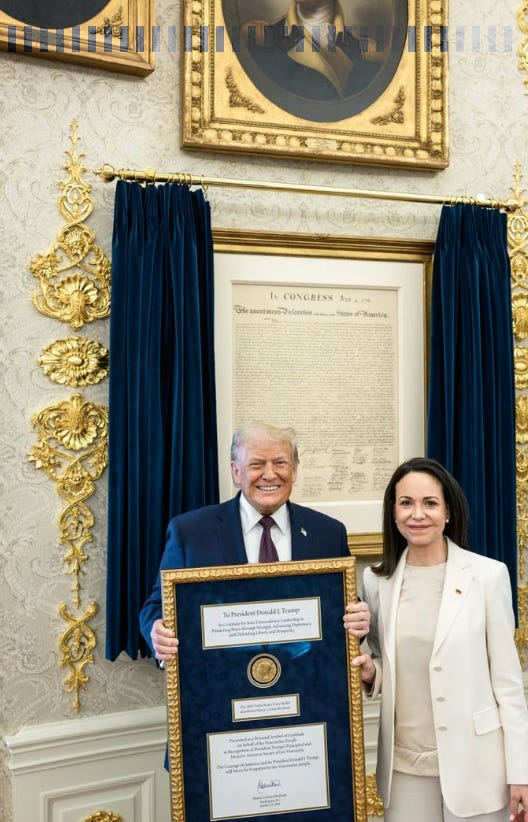
Behind President Trump, the Declaration of Independence loomed — a text forged in opposition to tyranny — while a peace prize was used to celebrate actions widely understood as regime change by force. Machado has publicly praised Trump’s role in Venezuela’s upheaval, even as fundamental questions remain unresolved: interim governance, elections, and control of national resources.
Symbolic though it may be, the handover demonstrates how readily prestigious awards can be reinterpreted to legitimise power.
What followed in the media was equally revealing.
Major mainstream outlets — including the BBC, The New York Times, CNN, Reuters, The Washington Post, and PBS — reported extensively on the handover, the incredulity in Norway, and the Nobel Committee’s clarification. They noted President Trump’s long-standing desire for the prize and analysed the geopolitical implications.
Almost none mentioned Julian Assange’s complaint filed only weeks earlier.
No connection was drawn between his warning and the events that followed.
Independent outlets — including WikiLeaks, Al Jazeera, and France 24 — had reported on the complaint in December, highlighting both its legal and moral significance. Even Wikipedia records both events on the same page. Yet mainstream reporting largely declined to bridge the gap.
That silence is telling.
Julian is vindicated not only in substance, but in outcome. He was totally right to challenge the award. The failure of much of the press to provide context exposes a deeper reluctance to scrutinise how symbols of peace are co-opted by power.
Julian Assange’s warning and this ceremonial gesture are inseparable. Both challenge us to defend integrity within global institutions. Both force the same question: when peace prizes honour support for military action, what becomes of genuine fraternity between nations?
And when context is quietly omitted, who is left to hold power to account?
The Archive exists to ensure these questions remain accessible — for researchers, students, activists, and future generations. The struggle for transparency and accountability is ongoing, and it must be preserved.
For the Julian Assange Archive, this moment is not merely news — it is continuity.
The Archive preserves thousands of letters sent in solidarity during Julians isolation, protest banners carried through streets across the world, artworks of resistance, and personal belongings entrusted by Julian Assange and his team. Together, they document grassroots power: vigils held in the cold, sustained campaigns, and the enduring belief that truth matters.
As preparations continue for the Archive’s exhibition in Dessau, opening in 2026, it will become a living resource — physical, digital, and exhibition-based. Visitors will encounter history directly: letters that crossed borders, banners that filled public squares, and objects bearing the weight of sacrifice.
Events such as the 15 January handover belong within this record — documented, contextualised, and open to examination. They reveal patterns: how honours are repurposed, how narratives are shaped, and why independent scrutiny remains essential.
Headlines fade quickly, but the questions endure.
If you hold materials, stories, or reflections from the global movement supporting Julian Assange, we invite you to contribute. Every piece helps ensure that moments of clarity are not lost to time.
For more visit our Website: click here
Subscribe to stay connected:
All of our content will always remain free to read. There is no paid subscription required to access our work.
A paid subscription is offered solely as a way for readers to -directly support the Archive, - its preservation work, and the development of our space in Dessau.
Thank you for reading The Julian Assange Archive.
See you in Dessau.
Manja
For The Julian Assange Archive e.V.
Support the Julian Assange Archive
The Julian Assange Archive is an independent, non-profit registered association, dedicated to preserving the historical record of Julian Assange’s work, the global movement for press freedom, and the struggle for transparency and accountability.
If you value independent archives and the preservation of truth beyond headlines, please consider making a donation.
Your support helps us:
* Preserve and digitise historical materials
* Maintain public access to the Archive
* Develop exhibitions and educational resources
* Establish our permanent space in Dessau
Every contribution, large or small, helps ensure this history remains accessible for generations to come.
Thank you so much!
A paid subscription is offered solely as a way for readers to -directly support the Archive, - its preservation work, and the development of our space in Dessau.
The last peace prize awarded to a US president by the Noble Committee went to Obama, when he hadn’t been in office long enough to earn any prize. He certainly didn’t turn out to be very peaceful. Several others have been awarded to those who didn’t deserve them. I can’t see this one as being worse.
Clearly the Nobel Prize lost all credibility long before the Trump debacle. And they aren't the only one's. FIFA awarding him a fake peace prize made my head spin. I realize FIFA Peace Prize didn't carry quite the same prestige as the Nobel Prize, but because of their shady and controversial nomination practices, its now right on par. FIFA's President is as corrupt as Trump so not really a surprise there. They both like presents and shiny objects. Should I watch my back, I hear football fans are quite earnest in their loyalty.